
AI and Filtration in Data Centers: Why Clean Air Is Critical for On-Site Power Generation
Filtration is a key factor for the availability, efficiency, and service life of gas turbines, gas engines, and fuel cells in data centers.
Artificial intelligence (AI) is one of the most important technology trends of our time and is transforming the entire advanced industrial world. It has the potential to fundamentally reshape society and the economy, and that potential is enormous.
Yet as large as AI's potential are the energy demands of data centers, which form the backbone of this technology. Data centers are among the largest energy consumers in the world. According to calculations by the consultancy International Data Corporation (IDC), global data center electricity consumption will double between 2023 and 2028, with an average annual growth rate of 19.5% over this five-year period. The Electric Power Research Institute assumes that by 2030, data centers could consume up to 9% of all electricity generated in the U.S.
A similar problem is emerging in many markets: expansion of power grids is not keeping pace with the rapid growth of data centers. Grid connections are delayed, high-capacity connections are scarce, and approval processes are lengthy. For example, in spring 2026, the city of Frankfurt am Main announced that new large high-capacity connections in this city, which hosts one of the world's largest internet hubs, cannot be expected before around 2035.
"The growing energy consumption associated with AI is already outpacing the development of the power grid, which is built on a multi-decade horizon. Data center expansion is therefore hitting a fundamental capacity limit." - Goldman Sachs, Vice President and Gartner analyst
That is why more and more data center operators are focusing on on-site electricity generation. It makes them less dependent on distribution grid capacity, enables better planning of construction projects, and helps bring new projects online faster. At the same time, it provides greater resilience in case of grid outages or delays in grid expansion. An on-site power source can cover the primary load of a data center, bridge the period until grid connection is available, or complement regular grid supply.
Today, three technologies are emerging as the most promising energy sources. Gas turbines offer high output and flexible operation. Gas engines enable modular solutions with multiple units and often achieve higher efficiency. Fuel cells represent a quiet, easily scalable power source with lower emissions, suitable for continuous operation.
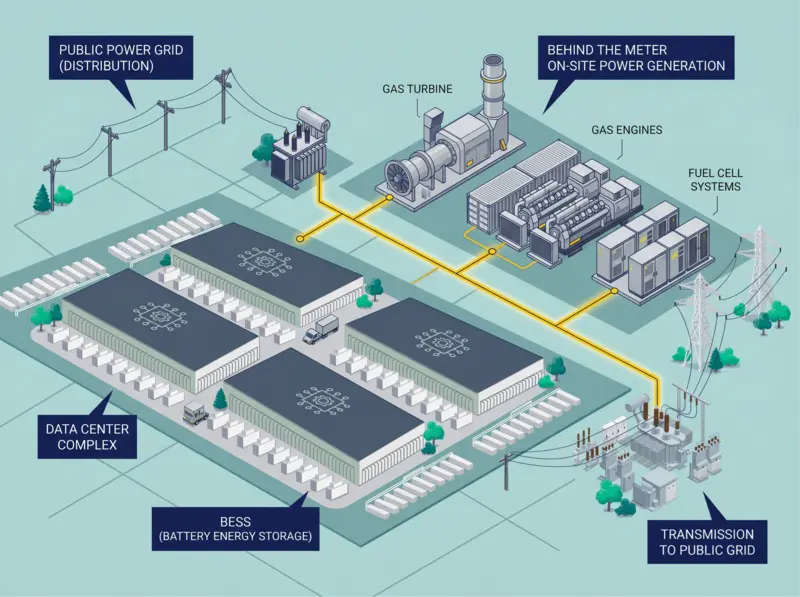
Gas Turbines
Gas turbines are suitable for projects where high output must be secured quickly or where significant step increases in demand must be covered. They are used primarily in large data center campuses or in situations where grid capacity constraints require a strong on-site power source. Their main advantage is high power density and suitability for large-scale energy systems. Compared with solutions based on multiple gas engines, however, they usually offer a lower degree of modularity.
Gas Engines
Gas engines are a strong solution for local power generation, especially where data centers need to grow modularly, increase load gradually, or ensure high availability through a larger number of smaller units. They work well in multi-engine configurations that simplify maintenance and redundancy while reducing the impact of failure of an individual unit.
They are also attractive to operators because they can ramp up quickly to the required output and can be used in island mode or for grid support. Gas engines therefore often represent a pragmatic response to insufficient grid capacity and long waiting times for connection, especially in regions with limited electricity availability.
Fuel Cells
Fuel cell systems are an attractive option for quiet, scalable, and locally low-emission power supply. Especially when hydrogen is used, they can operate on-site with very low emissions. This technology can therefore significantly reduce the environmental footprint of data centers and help improve air quality and climate protection.
Fuel cell systems can be used as a primary power source or as a supplement to grid supply. They are therefore attractive for operators who want to combine high reliability of energy supply with emission reduction.
Filtration Is a Decisive Factor for All Three Types of Power Generation
Across all on-site power generation technologies, filtration is an important factor for the performance, availability, and efficiency of AI infrastructure. It protects sensitive components from particles, moisture, and other contaminants, reduces pressure losses, extends equipment life, and thus lowers both failure risk and operating costs. Filtration therefore has a direct impact on performance, service life, and cost efficiency of on-site power assets.
Gas turbines need clean intake air because particles and moisture can contaminate turbine blades, compressor stages, and the entire system. The goal is not only to protect the gas turbine itself, but also to ensure stable operation. Reliable filtration helps reduce performance losses, wear, maintenance costs, and fuel consumption. Hengst therefore offers intake air filtration systems for gas turbines, including filtration media, pocket filter elements, filter cartridges, and cassette filter elements.
In gas engines, filtration is important because it protects the intake system and engine compartment from dust, dirt, and other airborne contaminants. This protection is especially important for data centers that rely on high availability, because unplanned downtime can quickly become very costly. Properly selected filters reduce wear on cylinders, pistons, and other components, and have a direct effect on maintenance costs and equipment life. For gas engines, Hengst mainly offers intake air filtration systems with suitable pocket filter elements or filter cartridges.
For fuel cells, the cathode air filter is essential, because efficient electricity generation requires a sufficient supply of clean air with minimal pollutant content. Hengst filtration solutions, tailored to specific applications, help keep airflow to fuel cells free of particles and harmful gases. This contributes to longer system life and higher efficiency.
How Air Filters Affect the Energy Consumption of Data Centers
While gas turbines, gas engines, and fuel cell systems solve energy supply for data centers, filtration can also positively influence the energy consumption of their HVAC systems.
Data centers are equipped with air conditioning units that cool air heated by IT operations. They typically operate in recirculation mode with high airflow. The largest share of energy consumption here comes from fans that draw in and move air through the system. With energy-efficient air filters optimized for low pressure drop, systems can be designed to reduce energy consumption. For data center operators, this also means lower CO2 emissions and reduced operating costs.
Conclusion
AI, on-site power generation, and filtration are connected more closely than it may seem at first glance. As data center energy demand continues to grow, local power sources are becoming increasingly important. But for gas turbines, gas engines, and fuel cells to fulfill this role reliably, they require properly designed filtration.
For technical managers and others responsible for infrastructure design, this means one thing: anyone addressing on-site power generation, supply security, and energy efficiency in a data center should include filtration in the system design from an early stage. Filtration has a direct impact on availability, efficiency, maintenance, and equipment life. It is therefore an essential part of high-performance AI infrastructure that remains viable in the future.